
At the Connecting Europe Days in Brussels form September 29 to October 1, 2026 in Brussels, with a record 4.500 participants present, EU Commission president Ursula von der Leyen pointed to the need to “adapt to a changing climate and a more volatile world ……. maintaining what we have is not enough.” She indicated that more work is need to effectively close the remaining gaps in cross border connections, as well as to keep Europe at the forefront of transport innovation and to build infrastructure ready for the climate of tomorrow. Surprisingly this edition did hardly feature hydrogen as a one of the EU’s leading global industry sectors.
As European companies dominate half of the global market for rail equipment and services and 70% of the world’s airspace is managed by technology made in Europe, also the EU electric truck and charging community was this year’s EU-made electric trucks have tripled over the last three years to currently 26 000 zero-emission trucks on Europe’s roads and a projected 400 000 by 2030. The EU Clean Transport Corridors Initiative, since March 2025 is fast-tracking at least 400 electric truck charging locations with over 2,900 charging points along two heavily used corridors on the Trans-European Transport Network (TEN-T), namely the North Sea-Baltic (Belgium, Netherlands, Germany, Poland, Lithuania, Latvia, Estonia, Sweden and Finland) and Scandinavian-Mediterranean (Sweden, Finland, Denmark, Germany, Austria, Italy and Malta).
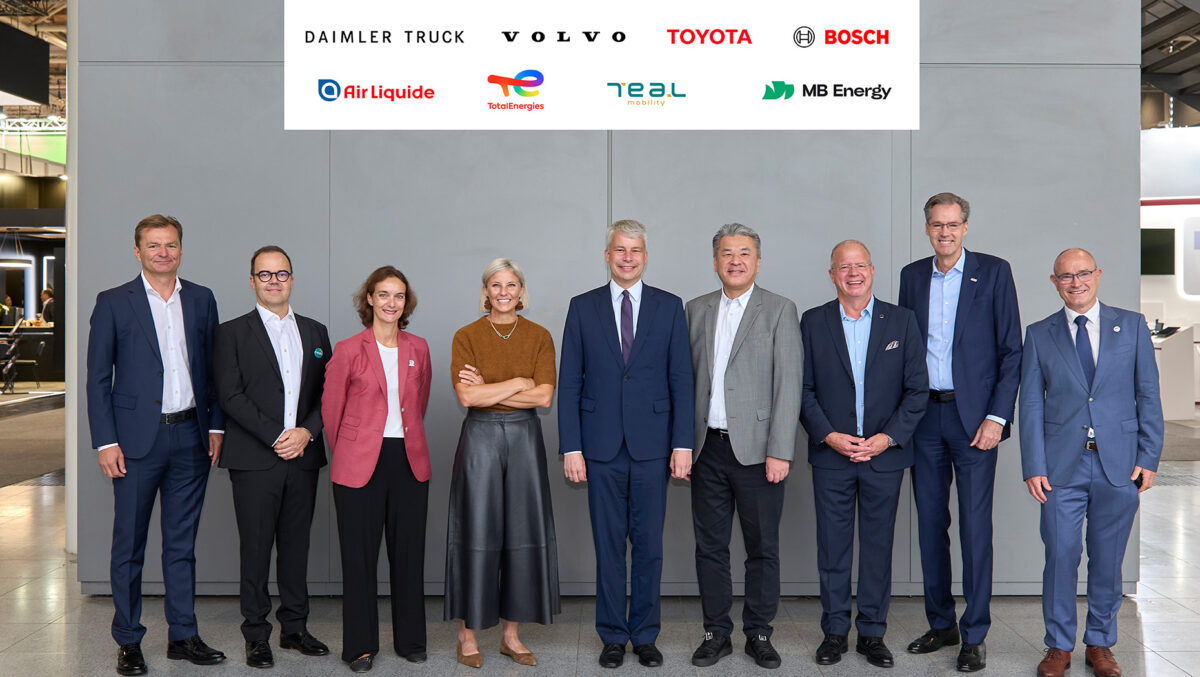
On the first day of the CEF Days, parity with higher diesel prices has been asked at EU level by Air Liquide, H2Accelerate, and a group featuring Daimler Truck, Volvo Group, and Toyota urging the EU to replicate Germany’s policy framework:
- Combined Funding Scheme: Launched in January 2026, the €220 million Federal Ministry for Digital and Transport (BMDV) subsidy program links the acquisition of hydrogen commercial vehicles directly to the rollout of high-capacity refuelling stations. The program drew 526 applications by its mid-2026 deadline.]
- Zero-Emission Toll Exemptions: Heavy duty zero-emission vehicles receive significant infrastructure charge exemptions under the Eurovignette Directive, offering an immediate and highly predictable operating cost advantage.
- RED III THG Quota Trading: Germany uses a greenhouse gas reduction quota system. Under the latest Renewable Energy Directive (RED III) standards, fuel suppliers must hit carbon intensity reductions (a 12% reduction target for 2026), generating lucrative credit trading options for operators who supply renewable hydrogen to the transport sector.
Subsequently on October 1, 2026 Air Liquide and Total Energies’ hydrogen refuelling joint venture (JV), Teal Mobility, announced a “symbolic” cut of H2 prices at all of its nine Benelux heavy duty refuelling stations to €9.95/kg: Deventer, Utrecht, Roosendaal, Rhoon, Capelle aan den IJssel, Veldhoven, Delfzijl, Zaventem and Bettembourg.
According to Apostolos Tzitzikostas, EU Commissioner for Sustainable Transport and Tourism, the focus of the EU TEN T corridor program has completely swifted to connectivity, capacity and military needs. For the total of the 9 corridors this will amount to a total cost of 845 bln by 2040, 500 of which up to 2030. As of EU funding the Commission has proposed a budget of 51.5 bln, currently 26 bln, for the completion of the key TEN T projects from 2028 – 2034, of which 17 bln for military purposes. In a panel fired on by the Commissioner, the big question was how to find most of the 795 bln not funded by the EU.
Especially the military portfolio was presented as a driver to increase connectivity and capacity, as well as, finally to establish the EU Single Market, or more specifically an EU Savings and Investments Union, that was highlighted again by Enrico Letta , citing his 2024 report, Much More Than a Mark. Mr. Letta stressed the need to turn the idea of a European single market into a reality in citizens’ and businesses’ daily lives. He argued that Europe’s main weakness is not simply its economic size, but the fragmentation of its markets, which prevents European countries from benefiting fully from their collective scale. Letta referred to the 42 measures and deadlines agreed by the European Commission, Parliament and Council that are being monitored measure by measure online, One Europe, One Market roadmap .
In a session on new Market Opportunities for Inland Waterway Transport, it became clear that inland waterways, with their potential for modal shift, have focused on moving bulk goods, but this segment seems to be declining. Other market segments, including those related to the energy transition and circular economy, like recycling of plastics and scrap, open up new markets. The water level issues around the different heatwaves this summer were topping the list of challenges. BASF referred to a dystopian future with no cargo transport in Europe if the EU would not prioritize funding for the necessary waterway infrastructure.
A panel on the TEN-T of the future, examining how emerging technologies can protect Europe’s transport infrastructure against climate risks, Elvira Haezendonck, Professor and researcher on (applied) sustainability, strategy and policy: cluster competitiveness, infrastructure and project management, VUB Brussels University referred to the need not only to look at infrastructure above ground but focus also on all pipeline and cable networks underground, like hydrogen pipelines and reinforcement of the electricity grid.
On the second day former Irish president of the European Parliament, Pat Cox, since 2024 European Coordinator for the Scandinavian – Mediterranean European transport Corridor, moderated one of the most interesting sessions on the resilience of the trans-European transport network, integrating lessons from transport and military experts to help put the 2025 Preparedness Union Strategy into full effect.
- Oleg Yakovenko, Director of Strategy and Innovation, Ukrainian Railways (UZ) indicate that despite everything for his operations people safety come first, every attack is analyzed and safety protocols are constantly adapted.
- Colonel Giancarlo Turco, Chairman of the Military Committee Working Group on Climate Change and Security, North Atlantic Treaty Organisation (NATO): indicated that better mapping of the transport corridors is needed, dual use means also the need for “dual resilience”. Also truly standardized border crossing protocols are eminent.
- Anna Dimitrijevics, Deputy Head of Unit Preparedness and Adaptation, Directorate-General for Climate Action (DG CLIMA), European Commission, referred to her Commissioner’s Wopke Hoekstra comment that climate resilience, energy security, and geopolitical independence are now inseparable: “All evidence shows that making the upfront investments is way cheaper than just being hit by fire, being hit by floods and then paying for the damage. That’s just way more costly,” An area twice the size of Luxembourg was lost to fires, this summer, while estimates of the economic damage range from €50 billion to €70 billion or more. The recent Heatwave plan, indicating a financial gap amounting to billions of euros, includes the setup of a Climate Insurance Alliance, noting that only around 25% of catastrophe losses in Europe are covered by private insurance. The Heatwave Plan also includes water needs but lacks references to the situation of waterways.
- Lothar Zeller, Senior Transport Expert, JASPERS Office Vienna, European Investment Bank (EIB): commented that new technologies like hydrogen should address the new hot spots for critical infrastructure needs: how will military goods move fastest to its destinations along which corridors and border crossings?
- Boryana Hristova-Ilieva, Head of Sector for Cybersecurity of critical infrastructure, Directorate-General for Communications Networks, Content and Technology (DG CNECT), European Commission . EU has a cybersecurity Act since 2026 that covers 18 sectors and recently the responsibility for securing cybersecurity is also moving to the company board rooms.
Specific sessions on the last day were dedicated to the new Workplans of the nine TEN T corridors. EHA follows the North Sea Baltic corridor (NSB) and the North Sea Rhine Mediterranean (NSRM) corridor as they include the first Synergy projects that link energy networks to transport energy needs. See page 24 for example of the NSB Workplan “The Corridor can learn from the early movers among us, for instance, from the Netherlands, which has already gained some experience with increasing synergies between the transport and electricity sectors.”
In the NSB corridor session, Catherine Trautmann, new Mayor of Strasbourg and Former European Coordinator for the North Sea – Baltic European Transport Corridor stressed the 150 bln, needed to complete all the planned 289 projects on the corridor. She also answered a question on hydrogen, mentioning that she was in favor of the use of hydrogen and referred especially the collaboration with Hamburg and the Netherlands on Synergy projects.
Eveline Verhaar, Policy Adviser, Ministry of Transport and Water Management, The Netherlands, highlighted the impact of climate change on the Netherlands, also on social costs. According to her ministry the integration of the energy and transport sector is challenging with regards to electrification. NL is working on facilitating synergy, by developing an UNECE regulation, subsidies for charging stations for trucks and supporting electric trucks, as well as supporting the use 40 zero emission construction equipment trucks.
The Irish presidency will guide the decision making on the CEF budget as of 2028; the hydrogen sector will have less than two years to prepare a EU-wide H2 tribe to set the scene for hydrogen in ensuring connectivity, capacity and resilience along the EU’s most critical corridors.